


STAUB Ceramics Production - Highest Quality and Elegance
From the beginning, STAUB has been producing the highest quality cookware. STAUB products are made of exquisite materials and are thoroughly tested repeatedly to ensure that they meet all the requirements of the modern kitchen.

Traditional craftsmanship
Each piece is individually manufactured according to traditional manufacturing methods. We place a great deal of emphasis on the "Hand Finished" label. During the manufacturing process, each piece is inspected to ensure compliance with our strict quality standards. It's best to watch our informative video on the manufacturing process.
MATERIAL AND SHAPE

The perfect tone
High-quality, natural raw material is the basis for ceramic production. The quality of the raw material and the perfectly balanced mixture of clay and water are crucial for the final result.

In good shape
A precise mould is created for each individual product to guarantee consistent quality. Each mould is marked with the "STAUB" lettering, which stands for careful manufacturing and quality.
THE PROCESS
In a single cast
The shape of the product determines the technique of production. In the case of liquid pouring, the exact portioning of the clay is essential. Here it is necessary to monitor that the liquid evenly fills each cavity.

Timing
Good timing is important when pouring. The perfect result is achieved only through the interplay of craftsmanship and experience.
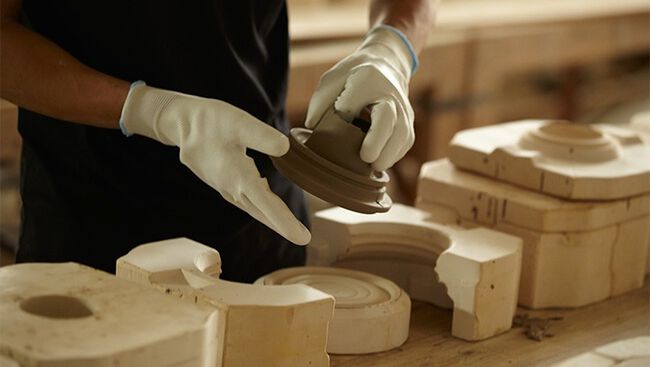
Handwork
After pouring, the product is lifted from the mould and ready for the next production step. With every further processing step, every handle must be executed precisely.
Die casting

Customized manufacturing process
Some products are manufactured using the die-casting process. This technique allows the product to rest longer in the mould.

Handwork
Production-related corrections are carried out manually. A steady hand and a good feel for the material are needed here.

Corrections
After the first manual corrections on the underside, the product is released from the mould. Now a first look at the ceramic is possible. Each mould has specific places during manufacturing, which can be corrected only by hand.
Rotation process

Portioning
For round ceramic products, the rotation process is the first choice. For this, the exact portioning of the clay material must first be carried out.

Shape and positioning
A precisely portioned quantity is placed in the mould for the respective product. The raw material is then prepared for the next step.

Rounding
The round ceramic shape is carved out with the ideal rotation speed at the perfect angle.

Releasing
After rotation, the product must be released from the carrier by hand. The production-related corrections are also carried out here.

Resting
After release, the round ceramic mould must rest.
Drying

Airing
The products are moulded and air-dried to obtain the perfect strength for the firing process.

DRY TIME
From experience, each ceramic mould needs time to dry to ensure high-quality standards.
Trimming and polishing
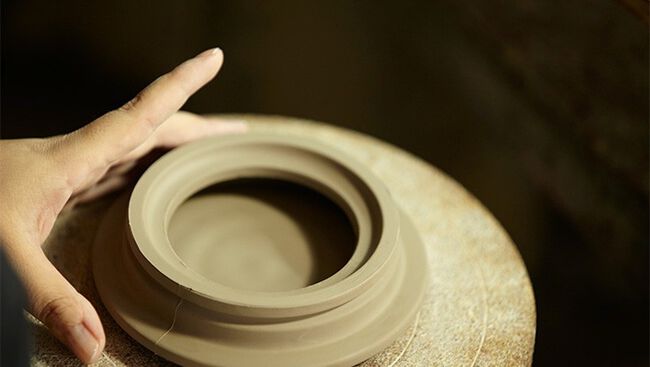
Handwork
For many moulds, precise fine-tuning must be done by hand. Many ceramic moulds are intricately designed, and some products require additional details that are applied by hand.

Lid
For example, knobs are always added and finished by hand.

Fine tuning
Ultimately, creating the best possible product takes a steady hand and a good eye.
COLOR GLAZE

Pigments
The enamel is made of glass powder and colour pigments, ultimately leading to the characteristic STAUB colours.

GLAZING
The glaze requires great sensitivity because the product must not remain in the glaze too short, but also not too long.

DIVING
Many hand movements and a lot of patience are required for glazing. It is necessary to work out the optimum colour firing and the ideal shade during the dipping process.

Emerged
After receiving the perfect glaze, the ceramic must rest and dry.
Firing process

Before burning
The ceramic products are still at rest. They are now pale and pastel, and it can only be guessed in what expressive STAUB colours they will soon shine.

In the oven
The colour and glass pigments fuse perfectly with the clay material at very high temperatures.

After the oven
The burning technique optimizes product quality, resulting in high resistance, reduced porosity and vivid colours.
Polishing

Final touch
Before storage, the ceramic products are finished by hand to ensure a high quality of workmanship.

Testing
The quality inspection ensures that the ceramic products meet the requirements of the modern kitchen.

Last control
Before careful packing, the product is checked again and then finished for worldwide shipment.


